Joe Borrell interveiw
Interviewer: Susan Jennison

Interviewer: Thank you for taking the time to chat with me today, Joe. Let’s start with your family history. I noticed you have a picture of your father. What part of Spain was your family from?
Joe Borrell: Our family came from a small town about 40 kilometers south of Barcelona. My father’s hometown was a small rural village, where they were farmers.
Interviewer: What led your family to leave Spain and move to Australia?
Joe Borrell: Well, Australia had a reputation for being a land of opportunity. My father and a group of about 20 relatives made the journey together. They originally went to Innisfail, Queensland, to work on sugarcane farms. Life in Spain was tough—markets were limited, and even something as simple as getting a full chicken was difficult. So when they heard about Australia, they saw it as a place to build a better life.
Interviewer: And what was life like for your father back in Spain?
Joe Borrell: He was a hard worker but not formally educated. That didn’t stop him from being sharp in business. He was always finding ways to make things work, whether it was on the farm or dealing in trade. He had a sense of humor, too—always quick with a remark to get a laugh out of people.
Interviewer: How did your family end up in Victoria?
Joe Borrell: My father had an accident in Queensland—he fell into a river, got pneumonia, and had to return south to recover. He moved in with his uncle in Bendigo, who was a tomato farmer. That changed everything for our family. Instead of staying in Queensland, we eventually settled in Keilor and started our own farm.
Interviewer: So that’s when your father started his own business?
Joe Borrell: Exactly. He started with a small fruit shop on Puckle Street in Moonee Ponds, but he was always thinking ahead. Instead of waiting for customers to come to the shop, he started delivering fresh produce to people’s homes. He bought a horse and cart, then eventually expanded to two horses and carts. He had a huge customer base, including doctors and lawyers.
Interviewer: What was life like growing up in Keilor?
Joe Borrell: It was a small farming community back then—completely different from what it is today. The land where Horseshoe Bend Road is now was all farmland. We lived in a house on the property with my parents and my siblings. My sister, Kath, had a tragic life, and my brother, Frank, had a son named Francis, but we weren’t close in later years.
Interviewer: What were the early days on the farm like?
Joe Borrell: Hard work but good times. We grew tomatoes and cauliflowers mainly. We’d wake up at 3:00 AM to load up the trucks and take the produce to the market. We had workers—mostly Italians—who lived on the farm in simple bunkhouses. They saved up and sent money back to their families before eventually returning home.
Interviewer: And you met your wife, Kath, while living in Keilor?
Joe Borrell: Yes, I met her at a local dance at the Keilor Hall. A friend brought her along, and the moment I saw her, I knew she was special. We got married at St. John’s in Essendon in 1942. No honeymoon—we went straight back to work on the farm!
Interviewer: You had some tragedy in your family. Would you like to share about that?
Joe Borrell: Yes, unfortunately. Our first son passed away at just 18 months old after a terrible accident in the kitchen. It was heartbreaking. And then our second son, Glenn, struggled with depression. He took his own life at 34. That was devastating. Depression is a terrible illness, and back then, people didn’t understand it the way they do now.
Interviewer: That’s incredibly difficult. How did you and Kath cope with these hardships?
Joe Borrell: Work kept us going. The farm, the community, our faith. We were active members of our church for many years. In fact, I recently received a great honor at our church for being one of the longest-serving parishioners. That meant a lot to me.
Interviewer: What are your fondest memories of Keilor?
Joe Borrell: The Keilor Gift—a famous footrace—was always a big event. The local flower shows, the auctions, and the sense of community. Life was simpler, and people looked out for each other.
Interviewer: Have you been back to Spain?
Joe Borrell: Yes, I went back with my family for a four-month visit. It was an incredible experience, but I realized Australia was home.
Interviewer: Looking back, what are you most proud of?
Joe Borrell: That we built a life here. We worked hard, we were part of a community, and we contributed to something bigger. Even with the hardships, I wouldn’t change a thing.
Interviewer: Thank you, Joe. Your story is inspiring, and I appreciate you sharing it with me. We’ll continue this conversation soon, and I’ll bring my camera next time to capture some family photos.
Joe Borrell: Sounds good. We can have a meal at the Keilor pub when we’re done!

Interview with Joe Brown
Interviewer Susan Jennison

Interviewer: Welcome, Joe! It’s a pleasure to have you here today. Let’s start by talking about your early memories. You’ve lived in this area for quite some time—what are some of your earliest recollections?
Joe Brown: Well, I’ve always been fascinated by the history of this town. My earliest memory goes back to the little family-run stores we had. There was a Shell service station, and right next to it were two small lolly shops. They were real community hubs! My father was a postman, and I remember spending time in one of those shops while he worked.
Interviewer: That’s wonderful. Can you tell us more about the historical aspects of the town? You seem to have a wealth of knowledge about its past.
Joe Brown: Absolutely. The McKinley family, for instance, were among the early settlers. Thomas McKinley arrived in Melbourne on October 26, 1852, and secured a lease shortly after. He worked for Mr. Bryte for six months before settling down. Then there’s Thomas Callaghy, another early settler, who arrived in 1853 with his family. These pioneers helped shape the agricultural and industrial foundations of our town.
Interviewer: That’s fascinating. Do you have any stories or personal connections to these early settlers?
Joe Brown: Oh, many! My family has ties to the Fox and Brown families, both of whom were deeply involved in the community. Richard Fox, for example, came from King’s County, Ireland, while Thomas Brown’s family originated in Sweden. These families built businesses, contributed to infrastructure, and helped develop the town into what it is today.
Interviewer: Speaking of infrastructure, were there any major developments or landmarks that stand out in your memory?
Joe Brown: Definitely. One of my favorites is the old bridge over the river. Before it was built, people used a ford to cross, which could be quite dangerous, especially during floods. I also remember the town’s original water wheel, which was crucial for milling operations. There’s an old photo I have of it—quite a beautiful piece of engineering!
Interviewer: That must be an incredible piece of history to hold onto. What about community life? How did people come together back then?
Joe Brown: The town was very close-knit. People gathered at the general store, the Blackman Shop, or at local events. One particularly fond memory I have is of the telegram delivery system—young boys would ride penny-farthing bicycles to deliver messages, which was quite a sight! We also had annual town picnics, sporting events, and concerts at the local school. I still have a concert ticket from the early 1900s—only a shilling for entry!
Interviewer: It sounds like a lively and connected community. What about the local businesses? Were there any particularly memorable ones?
Joe Brown: Yes! There was a hotel owned by Mr. Delaney, which was a popular gathering place. There was also a store run by the Salvine family, which sold everything from groceries to farming supplies. Another interesting figure was McDonald, the poet and writer, who spent much of his youth in our town. His works often reflected the landscapes and stories of this region.
Interviewer: It’s amazing how much history is packed into this town. Do you have any final thoughts or stories that you’d like to share?
Joe Brown: Just that history is something we should cherish. I’ve spent years collecting photographs, documents, and stories, and I always encourage people to do the same. These memories remind us of where we came from and how we’ve grown as a community. I hope future generations will continue to preserve and celebrate our town’s rich past.
Interviewer: Joe, this has been an absolutely fascinating conversation. Thank you so much for sharing your stories with us!
Joe Brown: My pleasure! Thank you for letting me share them.
Martha Toy Library
Interviewer Wally Day & Richard Whybrow
Interviewer:
We’re here today with some remarkable individuals who have played a key role in the story of the St Albans Toy Library. We’re joined by Faye Morgan, the long-time President of the Toy Library, as well as Lorraine and Keith Williams, early founders and community champions. Let’s dive into the history, the heart, and the heroes behind this beloved community institution.
Faye Morgan:
Thanks for having us. I’ve been part of the Toy Library for a very long time—over 20 years as President. It’s always been close to my heart.
Lorraine Williams:
And I’m Lorraine, and this is my husband Keith. We were there from the beginning, back in 1961. We helped get everything started.
Interviewer:
So you were the original instigators?
Lorraine:
That’s right. It all started with a farewell for a dear local kindergarten teacher, Martha. She had always believed in children having access to educational resources and had this beautiful dream—something that would help kids in the St Albans area. So after she passed, we took up a collection in her honour, and that became the seed for the Toy Library.
Faye:
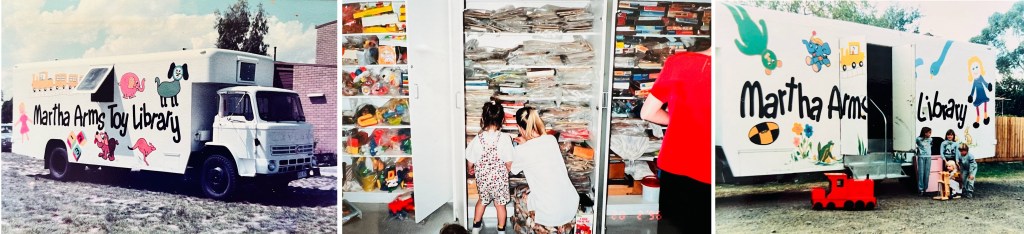
And then Rotary got involved. I was in Rotary at the time, and they decided to make this their community project. John Hodge, a Rotary member, helped convert a bus into a fully functioning mobile toy library—complete with shelving and everything!
Interviewer:
That’s incredible. So the Toy Library started as a bus?
Keith:
Yes, the bus would visit set locations—places like Errington Reserve in St Albans, and kindergartens in Kealba. Families would bring back toys and borrow new ones. It was a real community event.
Lorraine:
I remember it stopping at the Kealba kindergarten car park. That was my daughter’s kinder! The bus had quite the presence in those early years.
Interviewer:
And who coordinated all of that?
Faye:
A wonderful woman named Anne Robertson. She started as a parent but eventually became the Toy Library’s coordinator. Over time, the council gave us a small grant to pay her a stipend. She was amazing—keeping everything running, collecting toys, managing the library on wheels.
Interviewer:
What happened to the bus?
Faye:
Sadly, by the 1990s, the bus had become a bit of a liability. The upkeep was expensive, and it wasn’t roadworthy anymore. Eventually, it was retired and parked at the Westvale Community Centre. They turned it into a play area for kids, like a cubby house, until it rusted away. Before that, it spent some time parked behind the Kealba Village kindergarten, too.
Interviewer:
So after the bus, where did the Toy Library go?
Lorraine:
We moved into the Keilor Downs Community Centre, which was more practical. We set up cupboards and shelving there for the toys. That’s when the Toy Library really thrived. We had over 100 members at our peak!
Interviewer:
Wow! And how much was membership back then?
Faye:
It was around $18 a year for families back in the early days. Later, it rose to $30. Kindergartens could also join and borrow more toys, which helped support their programs.
Lorraine:
Back then, kindergartens didn’t have a big budget for equipment, so being able to borrow high-quality toys really made a difference.
Interviewer:
You mentioned amalgamation earlier. What happened there?
Faye:
When the Keilor and Sunshine councils merged to form Brimbank, everything changed. The Early Years and Community Services philosophy shifted. Because we charged membership fees, the council stopped giving us grants. That grant used to help cover the coordinator’s wages and the bus’s maintenance. Once that ended, we had to rely entirely on volunteers.
Lorraine:
We tried to keep it going. Everyone chipped in—volunteers helped run sessions, clean toys, do rosters. But families got busy, more women were working, and time was tight. Membership slowly declined—from over 100 down to 80, then 60, and eventually fewer than 40.
Faye:
It became harder and harder to keep going. But we made sure to finish on a high note.
Interviewer:
What did you do with all the toys?
Faye:
We contacted other toy libraries across the state. Some came from as far as Swan Hill to pick up toys. We held open days so people could browse our catalogue and collect items for their own communities. Since we’re a not-for-profit incorporated association, we had to distribute our assets to like-minded organisations.
Interviewer:
And what about the history? All the photos, the paperwork?
Faye:
We’re preserving all of it. I’ve got photo albums, documents—everything. I’d love for it to be scanned and turned into a proper record of our journey. It’s important people know where it all came from and why it was started.
Lorraine:
And it all started with Martha. People saw her name on the bus and assumed she ran it—but it was in her honour. She didn’t want a gold watch when she retired. She just wanted something that would keep helping children.
Keith:
She was the first kindergarten teacher in St Albans, working from a hall behind the church. After the church burned down, I built the altar in the hall, and the kindergarten continued there. Martha stayed involved for decades.
Interviewer:
That’s such a rich legacy.
Faye:
We even got mentioned in the Kindergarten Teachers’ Association magazine! Over the years, we were in the newspapers, promoted in kindergartens, and more. Now, we’re hoping to donate our archive to the Keilor Historical Society, to make sure it’s preserved.
Interviewer:
That sounds perfect. You’re part of this area’s history. From goldfields and iron bridges to toy buses and kindergartens—what an extraordinary story.
Faye:
It’s been a privilege. We just wanted to give back. And we hope our story inspires the next generation of volunteers to keep community projects alive.

 Keilor Historical Society